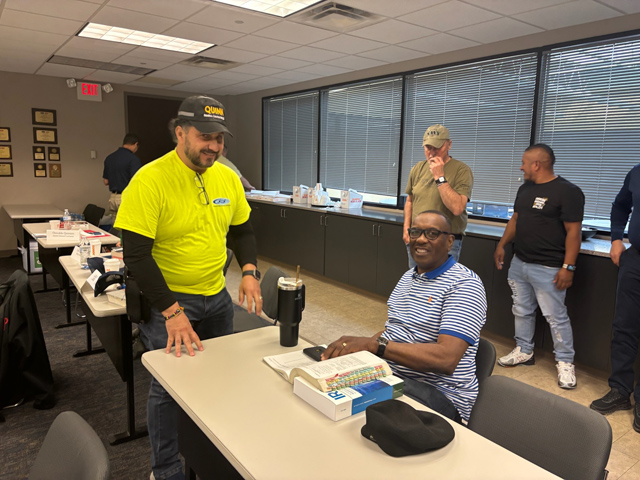
Continuing Education
Staying sharp on code is essential for every electrical, HVAC, and energy professional. EAP offers dynamic virtual and in-person continuing education designed to keep you current on both the practical application and underlying theory of today’s code requirements.
Our instructors include seasoned local electrical inspectors and expert partners from the Electrical Association in Minneapolis, MN. Their combined decades of real-world experience deliver the well-rounded, high value training that professionals rely on to stay ahead.
Upcoming Classes – Spring 2026
Class schedule is subject to change.
February
2020 NEC Ground and Bonding
Wednesday, February 11
8:00 am – 10:10 am
Zoom Webinar
Instructor: Mike Miller
2 CEUs: Philadelphia, Delaware, New Jersey, Pennsylvania (for Inspectors)
2 IEEE PDHs (requires additional $25 fee)
This two-hour Zoom webinar is designed to provide students with a deeper understanding of electrical grounding and bonding requirements as they apply to specific, critical occupancies outlined in the National Electrical Code (NEC 2020 edition).Upon completion of this webinar, students will be able to develop a comprehensive understanding of grounding and bonding requirements for:
- Classified hazardous locations, Health care facilities, Agricultural installations, Equipotential planes AND Mobile and manufactured homes.
- Effectively use the NEC (2020 edition) to locate and interpret information related to grounding and bonding in these specific settings.
Emergency Systems, NEC Article 700 Webinar
Wednesday, February 25
8:00 a.m. – 10:10 a.m.
Zoom Webinar
Instructor: Jim Dollard
2 CEUs: Philadelphia, Delaware, New Jersey, Pennsylvania (for Inspectors) *pending*
2 IEEE PDHs (requires additional $25 fee)
This webinar covers NEC requirements for automatic transfer to a separate power source when the normal supply is interrupted. Other codes/standards or municipalities mandate these systems for life safety, including egress lighting, exit signs, fire alarms, and certain elevators/ventilation systems. Requirements discussed include but are not limited to:
- Tests and maintenance
- Transfer equipment
- Wiring
- Signage
- Sources of power
- Unit equipment
- Lighting
- Overcurrent protection
March
NEC Article 625 (Electric Vehicles)
Wednesday, March 18
8:00 am – 10:10 am
Zoom Webinar
Instructor: Mike Miller
2 CEUs: Philadelphia, Delaware, New Jersey, Pennsylvania (for Inspectors)
2 IEEE PDHs (requires additional $25 fee)
This concise 2-hour Zoom webinar provides an essential, practical guide to Electric Vehicle (EV) charging system requirements using National Electrical Code (NEC) Article 625.
The session emphasizes real-world applications and examples to ensure attendees can immediately apply the code to their daily EV installation work.
Key Topics Covered
- Foundations for EV Systems: Evolution, Definitions (625.2), Voltages (625.4), Listing (625.5), Cords/Cables (625.17), Branch Circuits (625.40), and Overcurrent Protection (625.41).
- Installation & Safety: Power Transfer/Rating (625.42), Disconnects (625.43), Equipment Connection (625.44), Loss of Power (625.46), Multiple Circuits (625.47), Interactive Systems (625.48), Location/Ventilation (625.50, 625.52), and Personnel GFCI Protection (625.54).
- Advanced Applications: Wireless Power Transfer (Grounding 625.101 & Installation 625.102), Sample Circuit Calculations, and Equipment Nameplate Review.
April
NEC 2020: Motors and Transformers
Wednesday, April 8
8:00 am – 10:10 am
Zoom Webinar
Instructor: Mike Miller
2 CEUs: Philadelphia, Delaware, New Jersey, Pennsylvania (for Inspectors)
2 IEEE PDHs (requires additional $25 fee)
This intensive 2-hour webinar delivers a practical, application-focused review of two critical sections of the National Electrical Code (NEC 2020): Article 430 (Motors) and Article 450 (Transformers).The session uses real-world examples to help you immediately apply complex code requirements to your daily electrical work. Most of the session is dedicated to NEC Article 430, covering motors, motor circuits, and controllers. Key topics include determining ampacity for sizing components, distinguishing between NEMA and IEC motor data, and requirements for conductors, overload protection, short-circuit/ground-fault protection for both motor branch circuits and feeders, and specific rules for motor control circuits, controllers, motor control centers, and disconnecting means. The segment on Article 430 concludes with rules for adjustable speed drives. The remaining time addresses NEC Article 450 for transformers. Upon completion, attendees will be able to apply these critical NEC provisions effectively.
2017 vs. 2020 NEC Grounding and Bonding
Friday, April 24
7:30 am – 5:00 pm
Location: Universal Academy, Souderton, PA
Instructor: Marc Faulkner
8 CEUs: Philadelphia, Delaware, New Jersey, Pennsylvania (for Inspectors)
8 IEEE PDHs (requires additional $25 fee)
This 8-hour, in-person presentation is a focused seminar on the differences between the 2017 and 2020 National Electrical Code® (NEC®) editions, specifically concerning grounding and bonding.
The content is based on the IAEI PowerPoint presentation, which uses Soares’ Grounding and Bonding, Fourth Edition as its foundational text.
Key Topics Covered:
- Review of NEC Article 100 Definitions: Understanding the foundational terminology.
- Key Changes in the 2020 NEC: Highlighting the most significant updates in the new edition.
- The Grounding Electrode System: Detailed discussion of this critical system.
- NEC Article 250, Part III: 2020 Code Changes: Specific changes within the article section dedicated to grounding and bonding.
- Equipment Grounding Conductors: Reviewing requirements and proper application.
- NEC Article 250, Part VI, Bonding and Connections: Focusing on the rules for ensuring effective bonding paths and connections.
- NEC Article 250: Comprehensive review of the main grounding and bonding article.
- Key NEC Articles with Updates on Grounding of Specific Systems and Practical Applications & Scenarios: Examining grounding requirements for various systems and applying the code to real-world situations.
May
NEC Webinar: Motors, Controls, & GFCI
Wednesday, May 6
8:00 am – 10:10 am
Zoom Webinar
Instructor: Mark Miller
2 CEUs: Philadelphia, Delaware, New Jersey, Pennsylvania (for Inspectors)
2 IEEE PDHs (requires additional $25 fee)
This 2-hour Zoom webinar provides students with essential information from the 2020 National Electrical Code (NEC) covering Motors, Controls, and GFCI applications. Upon completion, participants will be able to apply these requirements to electrical installations and repairs in various situations.
The webinar is structured into three comprehensive parts:
- Introduction to Motor Conductors and Overload Protection
- Circuit Protection and Motor Controllers
- Disconnecting Means and GFCI Requirements
Requirements for Electrical Safe Work Practices
Wednesday, May 20, 2026
Time: 8:00 a.m. – 10:10 a.m.
Zoom Webinar
Instructor: Jim Dollard
2 CEUs: Philadelphia, Delaware, New Jersey, Pennsylvania (for Inspectors) *pending*
2 IEEE PDHs (requires additional $25 fee)
This presentation includes a comprehensive explanation of arc flash labeling and associated requirements in the NEC. These rules are expanding in scope with each NEC revision cycle and are tied to the arc flash labeling requirements found in NFPA 70E. To fully understand how to comply, this presentation provides an in-depth explanation of permitted arc flash risk assessment methods and other safe electrical practice requirements that impact installation requirements.
June
2020 NEC Branch Circuit, Feed, Service Calculations
Wednesday, June 3
8:00 am – 10:10 am
Zoom Webinar
Instructor: Mike Miller
2 CEUs: Philadelphia, Delaware, New Jersey, Pennsylvania (for Inspectors)
2 IEEE PDHs (requires additional $25 fee)
Master the essentials of electrical planning in just two hours! This focused webinar provides the knowledge and skills to accurately perform load calculations for branch circuits, feeders, and services across all occupancies, strictly adhering to the 2020 National Electrical Code (NEC).
What you will learn:
- Fundamentals: Sizing feeders/services (Art 230.23) and calculating general lighting and receptacle loads (Art 220.12, 220.14).
- Residential Expertise: Applying demand factors for key appliances, including ranges, dryers (Art 220.55, 220.54), and small appliance loads. This section includes single-dwelling examples and sizing of service conductors.
- Advanced Applications: Specialized load calculations for multifamily dwellings, schools, restaurants, and farm buildings (Art 220.84-102).
Fees
2 Hour Webinars:
$75.00/ Member
$100.00/Non-member
8 Hours In-Person Class:
$275.00/ Member
$325.00/Non-member
includes a light breakfast and lunch
IEEE PDH certificate: additional $25/fee
CEUs/PDHs
Webinars qualify for one or more CEUs in the following jurisdictions:
- Delaware
- New Jersey
- Philadelphia
- Pennsylvania (Electrical Inspectors, Engineers)
- IEEE Professional Development Hours (PDHs) for select courses for an additional fee.
Continuing Education Policies
Below are policies that govern EAP’s Continuing Education Programs.
Cancellation & Refunds
Webinars: Cancellations must be made, in writing, within 24-hours of the class start time to obtain a refund. If cancellation is submitted with less than 24-hour notice, the student will receive a credit to be applied to a future webinar within a 12-month period. If this credit is not used prior to the end of the 12-month period, student forfeits registration. Students may also transfer registration to another staff member at the same company. No shows will not receive a refund.
In-Person: These classes are held based on projected attendance, therefore once a student registers, there are no refunds. However, there are a few exceptions to this policy. If an extreme circumstance arises for the student, such as a death in the immediate family, severe illness, etc., a refund may be granted. A decision will be made on a case-by-case basis by EAP’s Executive Director. EAP will allow a company to substitute a student (i.e., change the registrant to someone else in the company) without penalty.
Cancellation, transfer, and refund requests should be submitted to us via email at electric@eap.org.
Student Conduct Policy
The Electrical Association of Philadelphia is committed to upholding the highest standards in continuing education. To maintain the integrity of our CEU/PDH offerings, students must be fully present and actively engaged throughout the webinar. Participation while driving, walking, working on a job site, or conducting other business is strictly prohibited. Any violation of this policy will result in the forfeiture of all CEUs/PDHs for the session and no refunds will be provided.
Questions?
Email Mair Malfara or call/text (215) 845-0985